ANZ Customer Tailored Pricing
Our most personal loan ever – redesigning the ANZ Personal Loans experience.

Project overview
Designing transparency into borrowing
For years, ANZ Personal Loans relied on static pricing: customers chose fixed or variable, but only learned their real rate after submitting an application. It was simple for the bank, but confusing for people. In FY22 Q3, ANZ set out to reimagine the experience with an opportunity to flip the model from apply to know → know before you apply, giving them clarity and confidence with a personalised indicative rate.
As the lead experience designer in the Credit Cards and Personal Loans squad, I worked end-to-end across discovery, research synthesis, interaction design, prototyping, shopfront IA uplift, calculator tools and UI implementation, collaborating with the content strategy and development teams to deliver one of ANZ’s biggest lending transformations.

Problem
Customers didn’t trust what they couldn’t see
Research revealed a consistent barrier: people abandoned applications because they didn’t know what rate they’d actually receive. That uncertainty undermined confidence and stalled conversions.
Pain points we observed:
Users wanted clarity on costs, repayments and borrowing power, not product jargon.
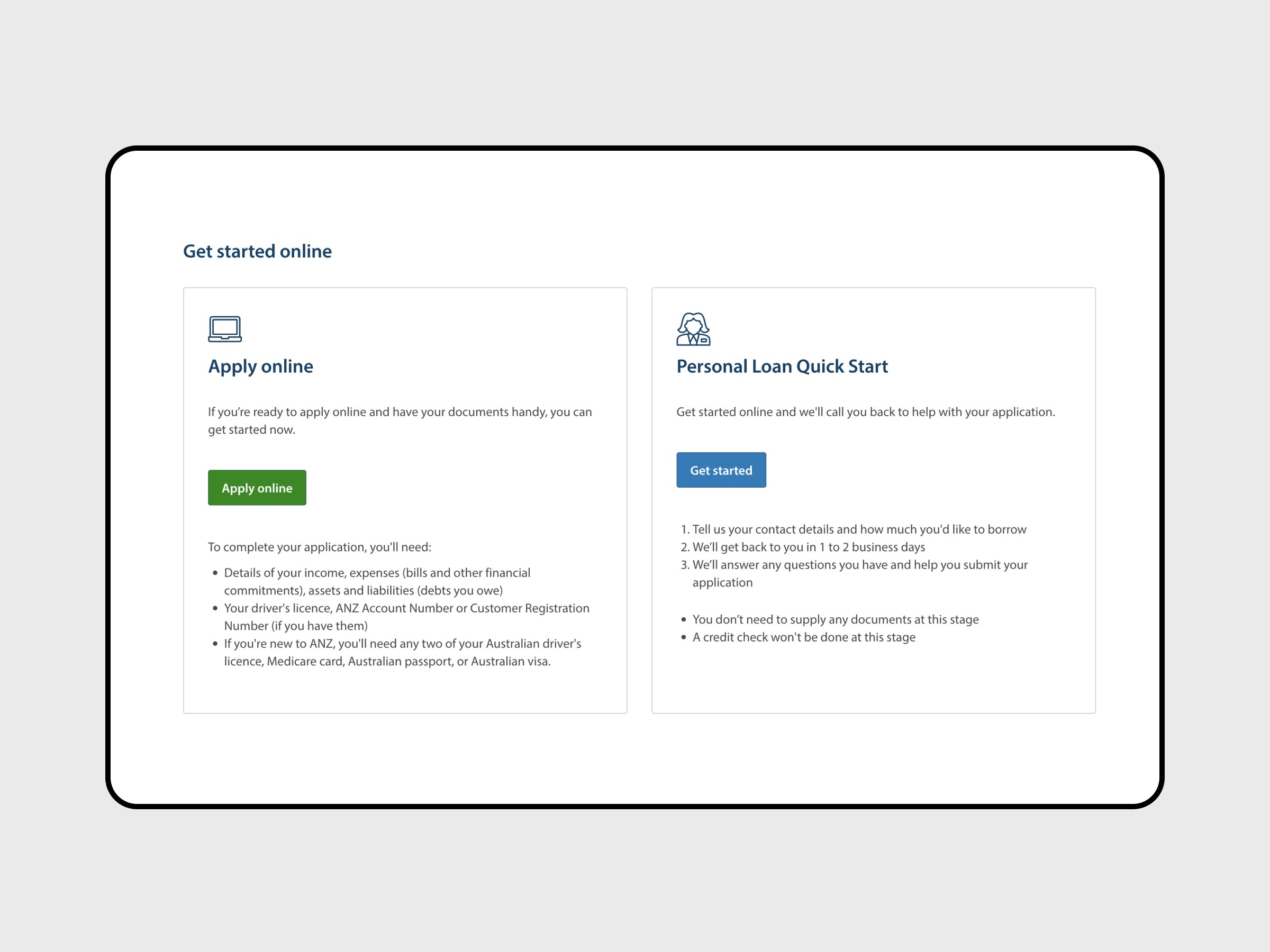
Critical CTAs sat below the fold buried under long paragraphs.
Dedicated product pages (loan for weddings, boats, travel etc.) had minimal engagement, while Compare and Calculator tools drove most traffic.
Goal
Make borrowing feel personal and trustworthy
Our mission was to turn a transactional process into a transparent one, where customers felt informed and in control.
Our goal was to:
Give users a personalised rate instantly and safely.
Simplify the application pathway while keeping it compliant.
Build trust and comprehension through plain-language content and inline education.
Challenge
Designing within boundaries
One of the biggest challenges I faced designing CTP was that the ANZ Horizon design system did not have any technical design guidelines or governance on tools and calculators, as they were designed and built in isolation, leading to inconsistencies across the web banking platform and duplication of effort when maintaining or scaling.
However our biggest constraints weren’t technical, they were privacy and compliance. Equifax’s liability meant we couldn’t store personal data pre-consent. This limited us to a no-data-retention MVP, requiring design trade-offs with legal. At the same time, we needed to meet the expectations of our Gradults target customer segments (18 – 34 yrs) who were digitally fluent, skeptical of fine print, and quick to disengage if something felt unclear.
Our squad reframed the challenge through a series of HMW statements:
How might we create a simple, reliable, and understandable CTP solution on the shopfront?
How might we help customers complete the process quickly and painlessly?
How might we educate and guide users so they can make informed rate decisions?
How might we maintain a sense of security and control throughout?
How might we encourage interaction with tools and visualise how personalised rates work?
How might we optimise the journey so people make the right decision at the right time?
Discovery
Users want clarity and results fast
We began with a deep audit of the personal loans ecosystem while collaborating with the lead content strategist.
Heatmaps and analytics revealed that our users rarely read content; instead, they jumped straight to calculators, rates and eligibility.
We re-imagined the information architecture to:
Maximise traffic flows to pages with high conversion rates.
Consolidate or remove poorly performing pages.
Add new pages to help people improve their financial wellbeing and capture trending search terms.
This audit led to a broader content uplift initiative focussing on:
A clear pathway to apply from conversion page headers.
Clear benefits, simple fees and charges, upfront eligibility details and information about what documents they'll need.
Uplifting repayment and borrowing calculators and ideally having these embedded on one page.
Research & Ideation
Distilling concepts for testing
To validate our ideas after some brainstorming sessions, we ran three iterative research rounds with in-market customers (15 total) to test the concepts on how people discover, compare, and apply for personal loans.
Round 1 – Concept exploration (5 users)
We tested 3 concepts: a widget above the fold, a multi-step application form, and an in-page embedded experience within the uplifted shopfront.
What we learned:
People used the tool mainly to compare and research, not immediately apply.
Terms like personalised rate and credit score were unfamiliar, requiring contextual education.
Iconography improved comprehension and confidence.
Multi-step forms were preferred over long scrolling pages, which felt overwhelming.
The widget outperformed all other concepts for engagement.
This helped us see that our audience valued clarity and simplicity, a quick way to explore rates first with gentle guidance toward applying.
Research & Ideation cont'd
Round 2 – Refined concepts (5 users)
We then presented the refined shopfront and form experience with the goal to make it feel more transparent and reassuring.
What we learned:
Widget remained the clear winner preferred by 80%.
Multi-step form increased confidence; users rated ease 6.6/7 on average.
Users expected to see a calculator result alongside their indicative rate.
Info-tips and alert bars gave confidence in unfamiliar steps.
50% preferred researching on mobile, then applying on desktop.
By the end, every participant understood what a personalised rate was, a sign our contextual education was working.
Research & Ideation cont'd
Round 3 – Calculator testing (5 users)
Finally, we tested the uplifted borrowing and repayment calculators on mobile and ran user scenarios with them to uncover any usability issues.
What we learned:
Interaction felt intuitive and modern.
Input loan fields felt more natural than the loan sliders, but sliders were interactive and useful once discovered.
Credit-score bands intrigued users but needed clearer definitions.
Comparison rate tooltip clarified meaning and prevented misinterpretation.
Users loved repayment frequency options and the ability to self-serve.
Overall, most users said they’d use these tools early in their research phase to compare competitors, confirming that confidence and transparency keep people engaged. Therefore, we know these can be leveraged at key moments throughout the customer journey to provide valuable experiences structured around customer needs whilst delivering on business outcomes.
Design solution
Estimate your rate leads the journey
The redesigned shopfront places the indicative-rate widget front and centre, immediately signalling transparency. During the design phase I created:
Lo-fi wireframes and concept explorations for the personalised-rate form, widget, and embedded shopfront module.
6 rounds of design iteration and 2 swarm workshops, using Rose Bud Thorn feedback across the Design Chapter to refine the prototypes.
An uplifted merged repayment + borrowing power calculator with tabbed navigation.
An uplifted shopfront with new content to focus on the ‘personalised interest rate’ journey while educating customers on credit scores, edge case scenario screens, higher placed apply CTAs, functionality and FAQs.
Confluence documentation outlining all the specs and partnering closely with engineering for Figma handoff.
The MVP version: shipped a static shopfront without the live widget first; latest update introduced the interactive widget to bring the ‘Estimate your interest rate’ proposition to life
Results & Impact
Within the first quarter:
18 - 20% increase in personal loan application completes, resulting in 300+ qualified leads per quarter ↑
35 – 50% visitors engaged with uplifted calculator tools ↑
25% interacted with tooltips ↑
15% drop-off reduction ↓

